
06 August, 2026
Demand for faux leather continues to grow across Saudi Arabia’s furniture, automotive, hospitality, marine, and commercial interior sectors. Buyers value its consistent finish, wide color choice, simple maintenance, and suitability for large projects.
However, choosing the best exporter is not just about finding the lowest price per metre. Material construction, heat resistance, abrasion performance, customization, quality control, documentation, and delivery terms all affect the final value. This guide explains how Saudi buyers can compare Indian suppliers, select the right PVC or PU material, and reduce sourcing risks.
Why Source Faux Leather from an Indian Exporter?
Product options for different Saudi industries
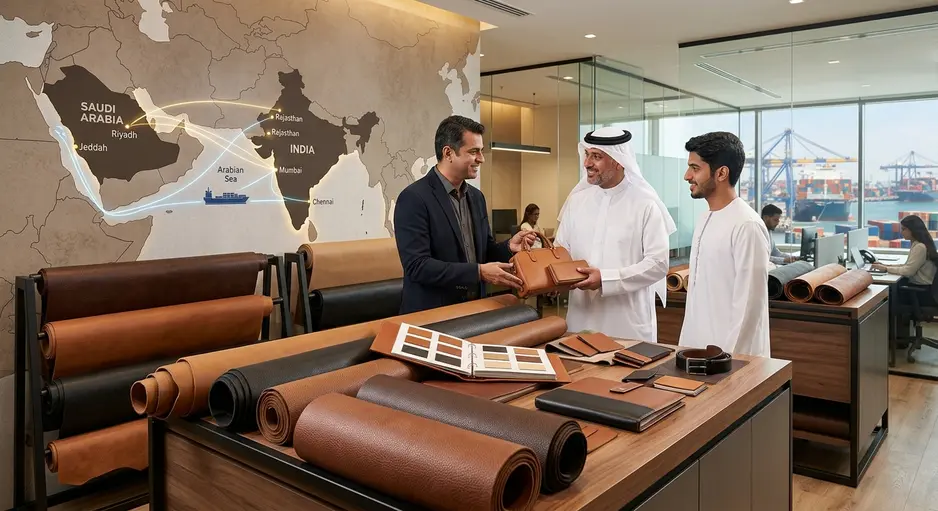
India offers access to varied coated fabrics for furniture, vehicle interiors, hospitality seating, decorative panels, and commercial spaces. Buyers can select a construction based on price, appearance, expected use, and care requirements.
PVC faux leather is often considered for economical and high-use upholstery. It tends to have a firm structure and a surface that is easy to wipe. PU faux leather is usually selected when a softer hand feel and a more supple finish are important.
Leatherette fabric can also be developed with different colors, grains, textures, backing materials, and surface finishes. An embossed faux leather design can recreate the visual character of natural grain while offering more uniformity across large production batches.
Customization and production flexibility
A suitable manufacturer may offer customization for color, embossing, thickness, width, backing, and gloss level. This is useful for Saudi furniture brands, interior contractors, and wholesalers that need materials aligned with a specific collection or project.
Customization is subject to production capability and minimum order quantity. Buyers should request swatches or development samples before confirming a bulk order. Private-label packaging and project-specific production should also be discussed directly with the supplier.
Commercial benefits of sourcing from India
India has established textile and coated-fabric supply chains. It may offer competitive manufacturing costs, product variety, and flexible development options. Sea shipments can be planned for Saudi ports such as Jeddah Islamic Port and King Abdulaziz Port in Dammam.
PVC vs PU Faux Leather: Which Is Better?
Neither material is automatically better for every application. The right choice depends on the required feel, cleaning routine, performance level, budget, and expected service life.
PVC faux leather
- Feel: Generally firm and structured.
- Water resistance: Often strong, depending on its construction.
- Cost: Commonly more economical than PU options.
- Uses: Furniture, covers, commercial seating, and other high-use surfaces.
- Checks: Flexibility, heat aging, UV stability, abrasion, and cracking.
PU faux leather
- Feel: Usually softer and more flexible.
- Water resistance: Varies with the coating and backing.
- Cost: Often higher than standard PVC material.
- Uses: Premium sofas, headboards, panels, and soft-touch interiors.
- Checks: Hydrolysis resistance, peeling, adhesion, and abrasion.
When should buyers choose PVC leather fabric?
PVC leather fabric can suit high-use furniture, commercial seats, and projects where easy cleaning and cost control are priorities. It may also be useful in environments exposed to occasional moisture. Buyers should still verify how the selected grade performs under Saudi heat and indoor sunlight.
When is PU leather material suitable?
PU leather material may be better for premium furniture and decorative interiors where softness matters. It is often considered for sofas, headboards, wall panels, and other touchpoints. The buyer should confirm hydrolysis resistance, coating adhesion, and cleaning instructions before approval.
Faux leather vs genuine leather
Artificial leather can provide more consistent color and grain across large orders. It is also easier to match when a project needs many seats or panels. Maintenance may be simpler, although this depends on the finish.
Service life cannot be judged from the PVC or PU label alone. Formulation, backing, coating thickness, exposure, cleaning chemicals, and daily use all affect performance.
Key Applications of Faux Leather in Saudi Arabia
Premium faux leather for upholstery and furniture
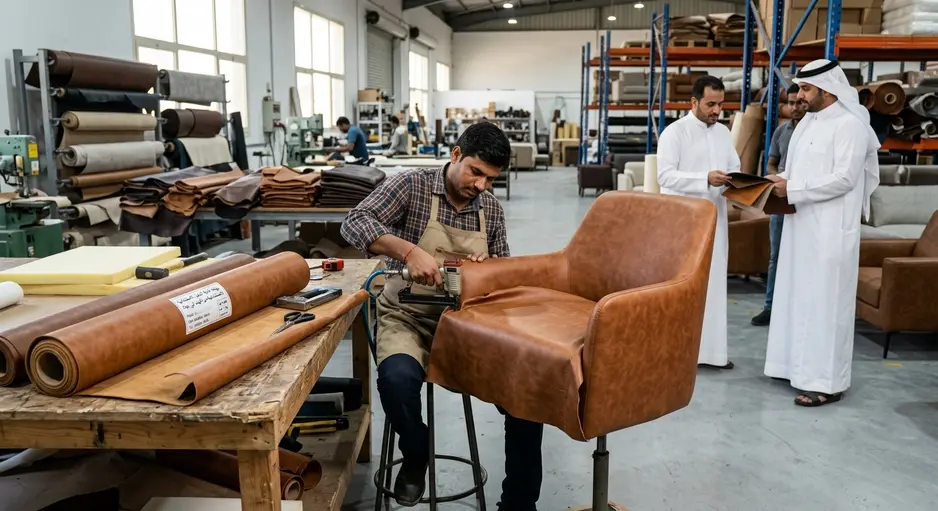
Premium faux leather for upholstery is used on sofas, chairs, headboards, wall panels, and office seating. It also serves as furniture upholstery material in homes, hotels, restaurants, lounges, and reception areas.
A sofa leather fabric should be assessed for cleanability, stain behavior, seam strength, surface recovery, and abrasion. High-traffic settings may need a different construction from residential furniture that receives lighter use.
Automotive upholstery leather
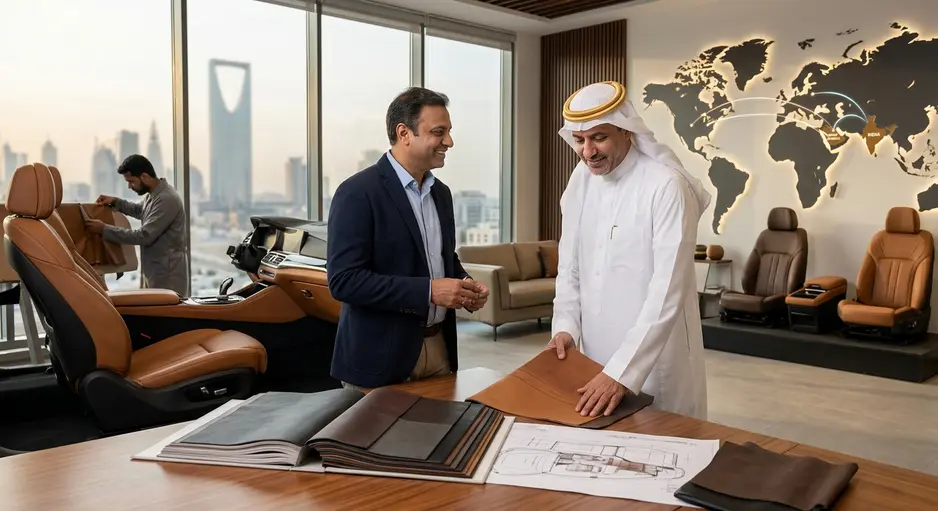
Synthetic material can be used for seat covers, door panels, dashboard accents, and interior trim. An automotive upholstery leather needs suitable flexibility, colorfastness, abrasion resistance, and heat-aging performance.
Buyers should request test data that relates to the exact automotive application. A product that performs well on an indoor chair may not be suitable for a vehicle parked in direct sunlight.
Marine and outdoor applications
Boats, waterfront seating, and selected outdoor installations may require waterproof synthetic leather, UV stability, mildew resistance, and simple cleaning. These properties should not be assumed from a product name.
Any product described as marine grade faux leather or UV-resistant faux leather should be supported by a clear specification or relevant test report. Buyers should also explain whether the material will face direct sun, salt exposure, humidity, or frequent washing.
Hospitality and commercial interiors
Hotels, cinemas, restaurants, clinics, and waiting areas often need durable, easy-care seating. Project-specific fire rules may apply. The Saudi buyer should provide the required flame-performance standard before sample development or production begins.
How Do You Choose a Faux Leather Exporter?
Confirm the complete product specification
A clear specification helps an international faux leather supplier quote the correct material. It also prevents comparisons between products that have different thicknesses, backing fabrics, or performance levels.
- PVC, PU, or another coating system
- Intended use and expected operating conditions
- Required thickness and GSM
- Roll width and roll length
- Backing fabric and stretch requirements
- Grain, embossing, and texture
- Gloss, matte, or semi-matte finish
- Approved color swatch or color reference
- Abrasion, UV, heat, hydrolysis, and cold-crack requirements
- Required flame-performance standard, where applicable
Request samples and supporting documents
Assess each sample for color, grain, hand feel, stretch, backing adhesion, and surface recovery. Ask the faux leather manufacturer for a technical data sheet and any available test reports relevant to the exact grade offered.
Keep an approved physical sample as the master reference. The purchase order should define acceptable tolerances for shade, width, thickness, roll length, and visible defects. Claims such as abrasion-resistant leatherette or eco-friendly leather alternative should only be accepted when the supplier can explain the standard and evidence used.
Evaluate manufacturing and quality control
Ask how raw materials are inspected and how coating, embossing, thickness, and shade are controlled. A reliable quality process should identify surface defects and measurement issues before rolls are packed.
Batch traceability and roll identification are also important. Labels should allow the buyer to link each roll to its design, color, dimensions, and production batch.
Compare commercial terms fairly
- MOQ for each design and color
- Sample or development charges
- Production time after approval
- FOB, CFR, or CIF terms
- Payment conditions
- Packaging method
- Shipment consolidation options
- Claim and replacement procedure
Actionable tip: Send the same specification sheet to every shortlisted faux leather supplier. A low quotation may reflect a thinner coating, lighter backing, shorter roll, or lower performance level.
What Is Required to Export Faux Leather to Saudi Arabia?
Classification and conformity checks
The correct HS code depends on composition, coating, backing, and construction. Buyers should not assume that every artificial leather product falls under one classification.
Before dispatch, the Saudi importer should confirm whether current SASO technical regulations apply and whether processing through the SABER platform is required. The importer, customs broker, and exporter should agree on the classification and documents before the goods leave India.
Typical export documents
- Commercial invoice
- Packing list
- Certificate of origin
- Bill of lading or airway bill
- Insurance certificate, when applicable
- Required product conformity documents
- Technical data sheets or requested laboratory reports
- Any required authenticated shipment documents
Packaging and delivery planning
Rolls need protective wrapping against dust, moisture, and handling damage. Strong cores and secured ends help maintain shape during sea freight. Labels should show the design, shade, batch, dimensions, and quantity.
Delivery plans should include manufacturing, inland movement, port handling, sea transit, and Saudi customs clearance. Avoid relying on a fixed transit estimate until a freight quotation and sailing schedule are confirmed.
Why Consider Rock Uniquoters as a Supplier?
Saudi buyers looking for a faux leather manufacturer in India can consider Rock Uniquoters as a potential sourcing partner. Selection should still be based on whether the available material matches the intended application and measurable project requirements.
Before ordering, ask Rock Uniquoters the following questions:
- Which PVC and PU constructions are currently available?
- Can color, grain, backing, width, thickness, or finish be customized?
- What is the MOQ for standard and custom designs?
- How does the sample-development process work?
- Which technical data and test reports can be supplied?
- What checks are completed before export packing?
- Which Incoterms and Saudi delivery ports can be supported?
- What is the expected production time after sample approval?
A Proven Process for Ordering from India
1. Prepare the specification
State the application, usage conditions, PVC or PU preference, dimensions, backing, performance requirements, quantity, and delivery location.
2. Review swatches and samples
Check appearance under relevant lighting. Test cleaning, flexing, adhesion, abrasion, and heat behavior as needed. Keep the approved swatch as a master sample.
3. Approve a pre-production sample
Confirm color, texture, construction, dimensions, and packaging. Add these details and the accepted tolerances to the purchase order.
4. Inspect goods and documents
For large or repeat orders, consider a pre-shipment inspection. Verify quantity, labels, measurements, shade consistency, packaging, and required paperwork before departure.
5. Measure supplier performance
Track on-time delivery, defect rate, batch consistency, response time, claims handling, and total landed cost. These measures provide a better view of value than unit price alone.
Best Faux Leather Export to Saudi Arabia
Choose an Exporter Using Measurable Criteria
Selecting a faux leather exporter to Saudi Arabia requires both technical and commercial checks. Define the application, compare PVC and PU constructions, review samples, verify performance evidence, and confirm quality tolerances. Documentation, packaging, lead time, and landed cost are equally important.
Saudi importers, furniture makers, and upholstery businesses can contact Rock Uniquoters for current product details, sample options, and an export quotation. Share a complete specification and destination port to receive a more accurate proposal.
Frequently Asked Questions
1. Is synthetic leather good for upholstery?
Yes, synthetic leather can work well for sofas, chairs, panels, and commercial seating. The correct grade should be selected for the expected traffic, cleaning method, climate, abrasion level, and desired feel.
2. Is PVC or PU better for sofas?
PVC may suit cost-sensitive, high-use furniture that needs simple care. PU is often chosen for a softer, more premium feel. The final choice should consider flexibility, abrasion, cleaning, heat exposure, budget, and expected service life.
3. Is faux leather suitable for Saudi Arabia’s hot climate?
It can be suitable when formulated and tested for the intended setting. Ask about heat aging, UV exposure, colorfastness, flexibility, hydrolysis, and surface cracking, especially for vehicles or areas near direct sunlight.
4. What is the MOQ for importing from India?
MOQ varies by manufacturer, construction, shade, embossing pattern, and customization. Standard products may have lower minimums, while custom colors and grains can require larger production runs. Confirm the MOQ before requesting development.
5. Can an Indian exporter customize the material?
Customization may include color, grain, embossing, thickness, width, backing, and finish. Availability depends on production capability and volume. Request a development sample and approve written specifications before bulk production.