
06 August, 2026
Marine interiors must look inviting while dealing with sunlight, salt, moisture, spills, and constant use. That balance explains why faux leather upholstery for marine interiors is gaining attention among boat owners, yacht designers, upholsterers, and vessel operators.
Today’s materials offer more than a leather-like appearance. Selected products can support easier cleaning, consistent colors, and demanding seating applications. Yet not every coated fabric belongs on a boat. This guide explores leading faux leather upholstery for marine trends, compares PVC and PU, and explains what to check before choosing a material or supplier.
Why Faux Leather Is Shaping Marine Interiors
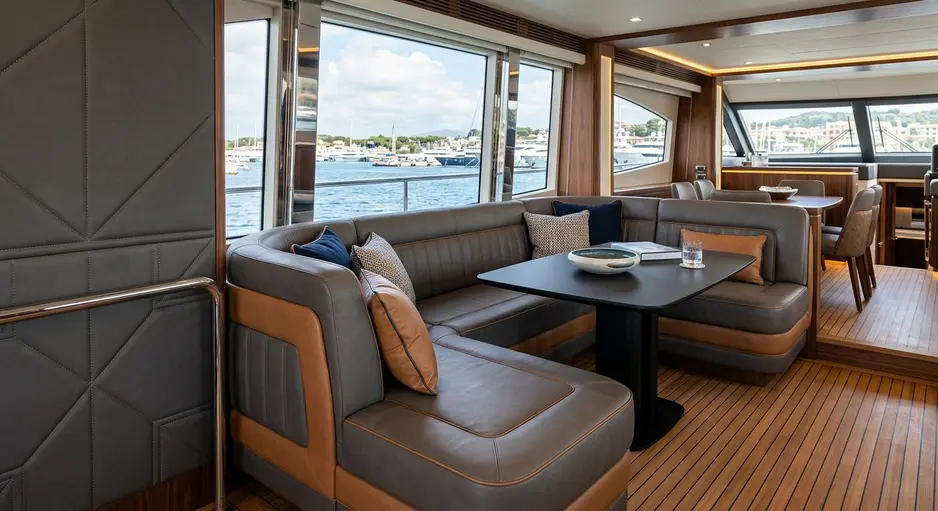
Modern marine spaces call for comfort without difficult upkeep. Faux leather can provide a consistent grain and color across seating, wall panels, headboards, helm stations, and cabin lounges. Its coated surface is often easier to clean than absorbent materials.
Benefits of Faux Leather for Marine Interiors
Suitable marine products may be engineered to resist UV exposure, moisture, abrasion, stains, and fungal growth. These qualities make them useful for boat seat upholstery and yacht interior upholstery where food, sunscreen, oils, and salt residue are common.
The material also gives designers broad control over texture and color. Fine grains can create a premium look, while coordinated shades help connect cabins, cockpits, and dining areas.
Is Faux Leather Upholstery Good for Boats?
Yes, when the product is designed and tested for the intended marine environment. Decorative furniture fabric should not be confused with marine grade faux leather. A boat material must match its level of exposure to water, sunlight, temperature changes, and wear.
The cover is only part of the seat. Thread, seams, foam, backing, ventilation, drainage, and installation methods also affect long-term performance.
Seven Faux Leather Upholstery Trends for Marine Spaces
1. Warm Neutrals and Coastal Earth Tones
Sand, oyster, taupe, driftwood, and warm gray are replacing harsh white in many marine interiors. Muted terracotta can add warmth without making a cabin feel busy. These shades work well with teak, brushed metal, composite decking, and natural-look panels.
Warm neutrals also create a calm base for future updates. Owners can change cushions or accessories without replacing the main upholstery.
2. Ocean-Inspired Accent Colors
Navy, deep teal, sea-glass green, and soft blue remain natural choices for boats and yachts. Instead of covering every surface, designers are using them on piping, helm chairs, side panels, and feature seating.
Color placement matters outdoors. Dark surfaces tend to absorb more heat in direct sun, so lighter shades are often more comfortable for exposed seating.
3. Matte Grains Over High-Gloss Finishes
Low-sheen finishes and fine leather grains create a quieter sense of luxury. Pebbled and lightly textured surfaces can also hide small marks better than glossy finishes, although cleanability depends on the actual coating.
This trend is especially visible in premium marine upholstery leather alternatives used for enclosed yacht lounges, dining banquettes, and wall panels.
4. Curved and Modular Marine Seating
Rounded banquettes, wraparound lounges, convertible berths, and movable deck modules make better use of limited space. These shapes require flexible, abrasion-resistant synthetic leather that can follow curves without losing its form.
Upholsterers should review stretch, recovery, backing stability, thickness, and seam strength. A beautiful surface will not perform well if it puckers or places too much stress on stitched areas.
5. Indoor-Outdoor Design Continuity
Designers are connecting cabin lounges with covered cockpits and deck seating through related grains and colors. The visual result feels unified, but the same fabric may not suit every location.
An enclosed cabin can prioritize softness and low odor. A semi-exposed deck may need stronger UV and weather performance. Coordinating different specifications is often safer than using one material everywhere.
6. Performance-First Luxury
Owners want easy-clean marine upholstery that feels refined rather than industrial. This has increased interest in soft-touch surfaces with documented resistance to sunlight, mildew, stains, saltwater exposure, and repeated cleaning.
The approach works for private yachts, charter boats, ferries, and cruise interior seating material. Each project still needs its own performance and compliance review.
7. More Transparent Material Choices
Buyers increasingly ask about low-VOC formulations, phthalates, recycled content, and chemical management. These are useful questions, but terms such as “sustainable,” “non-toxic,” and “eco-friendly” need evidence.
Request current test reports or certificates for the exact construction under review. Depending on the market, relevant documentation may include REACH, RoHS, Prop 65, or OEKO-TEX information.
Faux Leather vs Marine Vinyl: Which Is Better?
Marine vinyl is usually a PVC-based coated fabric made for demanding boat environments. Faux leather is a wider category that can include PVC marine upholstery, PU marine upholstery, and other coated materials.
| Factor | Marine-Grade PVC | Marine-Grade PU |
|---|---|---|
| Water resistance | Typically excellent | Depends on formulation |
| Leather-like feel | Good to very good | Often excellent |
| Outdoor suitability | Commonly preferred | Requires verified testing |
| Cleanability | Generally easy | Finish-specific |
| Hydrolysis concerns | Usually lower | Must be evaluated |
| Typical use | Open or semi-exposed seats | Protected premium interiors |
PVC Marine Upholstery
Marine vinyl fabric is widely used for exposed seating because PVC can offer strong water, stain, and weather resistance. Quality still varies. Softness, UV stability, flexibility, cold-crack performance, and backing strength should all be checked.
PU Marine Upholstery
PU often has a softer hand and a more natural leather appearance. It can suit enclosed lounges and cabins, but marine formulations need verified humidity and hydrolysis resistance. Standard furniture-grade PU should not be treated as marine material without supporting data.
How to Choose the Best Faux Leather Upholstery for Boats
What Makes Faux Leather “Marine Grade”?
“Marine grade” should describe proven performance, not serve as a general marketing label. Ask for a technical data sheet and review the tests that matter to your installation.
- UV resistance and colorfastness
- Water and salt-spray resistance
- Mildew or fungal resistance
- Abrasion, flex, and seam performance
- Hydrolysis resistance for PU constructions
- Cold-crack performance for colder climates
- Resistance to sunscreen, oils, and common stains
- Suitable backing, stretch, thickness, and recovery
- Required flame, smoke, and toxicity documentation
Common reference methods may include ASTM D4157 for abrasion, ASTM D751 for coated fabrics, ASTM G154 or ISO 4892-3 for UV weathering, and ASTM G21 or AATCC 30 for fungal resistance. Commercial vessels may also require documentation related to the IMO 2010 FTP Code or other applicable rules.
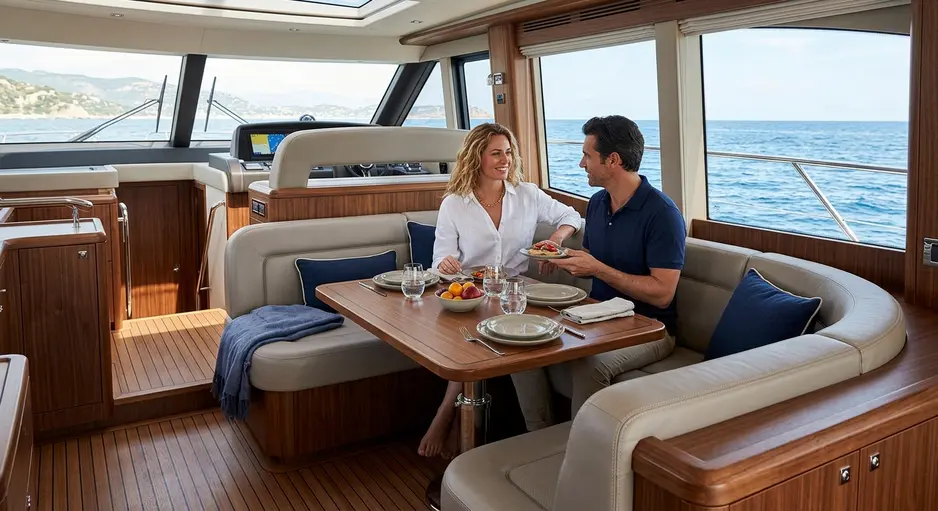
Match the Fabric to the Exposure Zone
- Open deck: Prioritize UV, weather, salt, water, and heat-aging performance.
- Covered cockpit: Balance moisture resistance with comfort and appearance.
- Enclosed cabin: Focus on tactile quality, cleanability, low odor, and color harmony.
- Passenger vessel: Review abrasion, batch consistency, cleaning compatibility, and fire requirements.
Do Not Rely on Marketing Labels Alone
Request application-specific samples and ask whether test results apply to the exact color, backing, and construction being ordered. View light and dark options in the vessel’s real lighting before approving bulk production.
Real-World Marine Upholstery Applications
Family Boat Seating
Sand or pale gray waterproof leatherette fabric can keep a family boat feeling bright. Contrasting piping adds definition, while removable cushions and drainage-friendly construction help manage spills, wet clothing, and sunscreen.
Premium Yacht Interiors
Soft-touch or matte PU may suit protected lounges, headboards, wall panels, and dining areas. More weather-resistant PVC can then be specified for exposed zones while maintaining a coordinated palette.
Ferry and Cruise Seating
Busy passenger areas need heavy-duty marine leather alternatives with suitable abrasion performance, stable production colors, and compatibility with approved cleaners. Flame and smoke documents may also be required for the vessel and destination market.
Marine Upholstery Maintenance Tips
How Do You Clean Marine Faux Leather?
- Remove sand and loose grit before wiping.
- Use fresh water with mild, pH-neutral soap.
- Clean salt, food, sunscreen, and oils promptly.
- Rinse away all soap and cleaning residue.
- Dry the surface with a soft cloth.
- Ventilate cushions and allow damp foam to dry.
- Follow the manufacturer’s approved cleaner list.
Prevent Cracking, Staining, and Mildew
Use breathable covers and avoid trapping damp air around cushions. Do not apply bleach, solvents, abrasive tools, waxes, or household leather conditioners unless the manufacturer approves them.
Inspect seams and high-friction areas often. Even when a coated surface is described as mildew-resistant upholstery fabric, fungal growth may appear on trapped dirt, food residue, or other organic matter.
How to Evaluate a Marine Faux Leather Supplier
Questions to Ask a Manufacturer or Exporter
Before selecting a marine faux leather supplier, confirm where and how the product can be used. Useful questions include:
- Is it intended for enclosed, covered, or fully exposed marine use?
- Are UV, abrasion, fungal, hydrolysis, and cold-crack reports available?
- Which cleaners and disinfectants are approved?
- Are compliant options available for commercial vessels?
- What are the roll width, minimum order, lead time, and color tolerance?
- Can repeat orders maintain acceptable batch consistency?
- Are samples and production-lot references available?
- Which shipping and export documents can be supplied?
Choosing an International Supplier
A dependable international marine faux leather supplier should provide clear specifications, sampling support, traceable product details, realistic warranty limits, and consistent quality control. A marine upholstery fabric exporter should also understand the documents needed for the buyer’s destination.
Contact Rock Uniquoters to request available marine upholstery samples, specifications, color choices, and export details. Any claims about waterproof, UV-resistant, saltwater-resistant faux leather or anti-fungal upholstery material should be confirmed through current product documentation.
Bring Modern Style and Proven Performance On Board
Current marine interiors pair understated luxury with practical performance. Warm colors, matte grains, curved seating, and coordinated indoor-outdoor spaces can all create a refined result. The final specification must also account for UV exposure, moisture, abrasion, cleaning, seams, and drainage.
Explore marine faux leather upholstery options from Rock Uniquoters and request samples, technical specifications, color selections, and export information for your next boat, yacht, or passenger-vessel project.
Frequently Asked Questions
1. Is faux leather waterproof enough for boat seats?
The coated surface may be waterproof or highly water resistant. However, needle holes, seams, backing, foam, and cushion design can still admit moisture. The complete seating system determines how well a boat seat handles water.
2. What is the difference between faux leather and marine vinyl?
Marine vinyl is generally a PVC-based type of faux leather engineered for marine conditions. Faux leather is a broader term that may include PVC, PU, and other coated constructions intended for many different environments.
3. Does marine faux leather get hot in the sun?
Any seating material can become hot under direct sunlight. Dark shades usually absorb more heat. Lighter colors, breathable covers, shade, and suitable heat-aging performance can make exposed boat seating more practical.
4. How long does marine faux leather upholstery last?
Service life depends on sunlight, climate, use, material quality, cleaning, storage, and seat construction. A fixed lifespan should not be promised unless it is supported by relevant field data and a written warranty.
5. What is the best faux leather upholstery for boats?
The best product is a marine-tested material matched to the installation zone, climate, traffic, cleaning routine, and regulatory needs. Compare samples, review technical documents, and test the chosen surface before placing a bulk order.